Let There be Light: The EoR
The Epoch of Reionization (EoR) is, in a sense, the beginning of the Universe proper, a time which the Universe gained order, form, and diversity it had not previously had. This period was arguably the most important part of the Universe’s history despite its short reign spanning from about 400 million years after the Big Bang up until approximately the billionth year of the Universe, and it is only recently that, with the help of some of the most impressive instrumentation hardware ever devised, this exciting period of the Universe is starting to come into view.
Now the earth was formless and void, and darkness was over the surface of the deep. And God said, “Let there be light,” and there was light. And God saw that the light was good, and He separated the light from the darkness. –Genesis 1:2-4
Indeed, in the beginning, the Universe was essentially formless and void. The Big Bang, a period in which the Universe expanded by untold factors, left a universe that was essentially isotropic (of the same shape no matter what orientation it was looked at) and smooth: every point in space was essentially indistinguishable from any other point in space.
While the Big Bang itself was a very hot event that allowed enough energy to fuse together the building blocks in protons and neutrons and electrons into the atoms that would eventually build the Sun and our Solar System, the ensuing period afterwards saw the universe cool to the extent where this could no longer happen.
This period, recombination, saw the opaque gas of ionized hydrogen (which was by far the most common atom created ine Big Bang) turn into molecular hydrogen, the kind that we recognize on Earth. This molecular hydrogen is clear to most types of light, and as such, the Universe became clear to light for the first time in its history, lifting the fog on the Universe that had been imposed on observers since its birth.
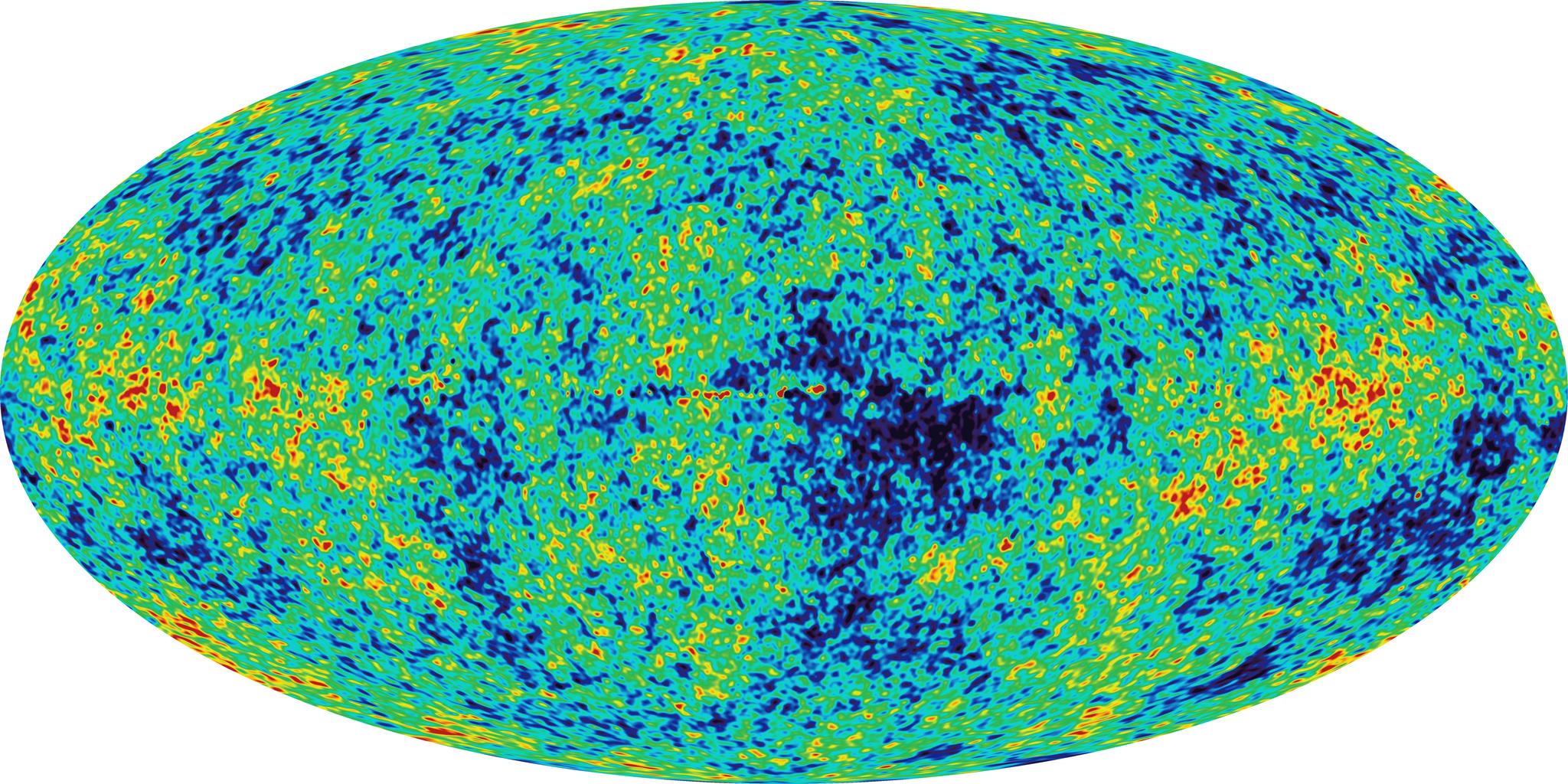 WMAP’s map of the CMB (Credit: WMAP Science Team, NASA)
The universe at this time is a huge volume of hydrogen of nearly uniform density. However, it is not quite perfectly uniform in density, a property reflected today in a snapshot of the recombination period called the Cosmic Microwave Background (CMB), which found that the Universe was warmer (very slightly) in some parts of the sky than others, and therefore slighly less dense, in the same way that the air in hot air balloons is less dense than the air around it. This slight lack of smoothness is essential in the creation of our very distinct and clearly not perfectly smooth Universe of today.
Why it is only a part per ten thousand away from being smooth while not being perfectly smooth is not known, as are many other questions about the reasons why the Universe’s starting conditions are such that they are. It is this very slight imperfection, however, that allows for what will soon occur to transform the Universe. The force now that is given sway in this uneven universe is one we experience every day: gravity. It is by the hand of gravity, then, that did the work of dividing the light from the dark to create the modern Universe.
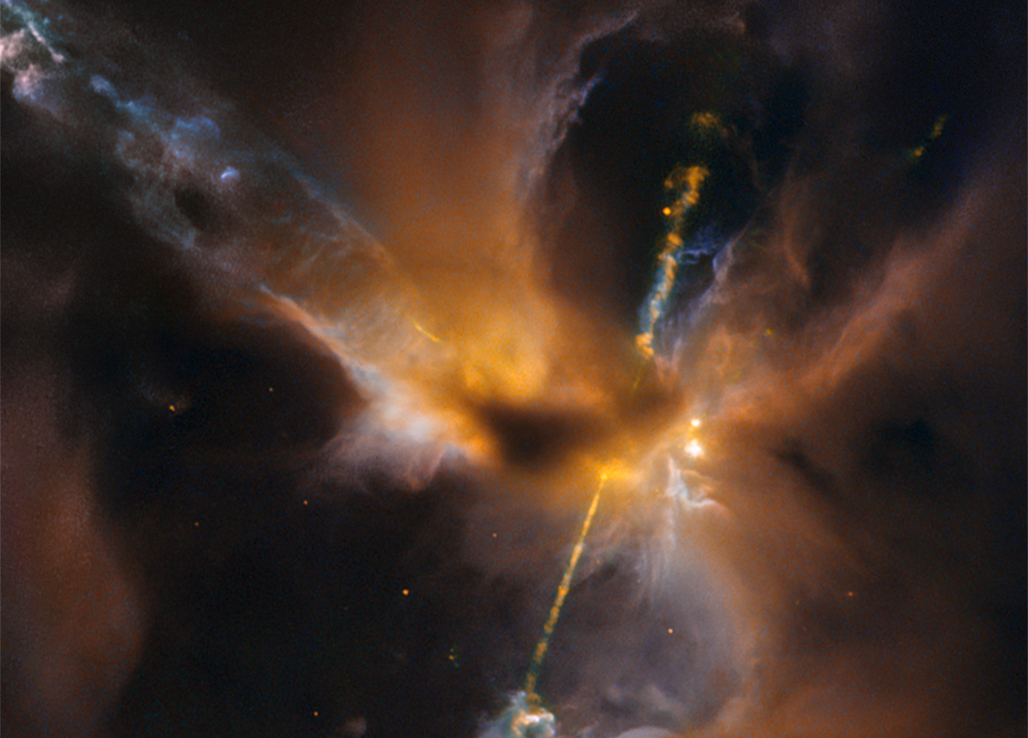 Protostar Herbig–Haro 24 (Credit: NASA, ESA, Hubble Heritage / Hubble-Europe Collaboration)
This is a contemporary protostar, a reasonable facsimile of what the earliest blooming stars in the Universe may have resembled. We cannot see individual stars form from this era, as they are some thirteen billion years in the past and therefore proportionally far away (due to the finite speed of light), but the physics are relatively similar now as they were in those early days.
Protostars like this one gain energy from the speed gained by particles collapsing inwards on the nascent star, giving them the energy that allows for the beginning of nuclear fusion, lighting the Universe anew with intense radiation capable once again of imparting enough energy into nearby hydrogen atoms to drive them into an ionized state, creating an epoch of reionization of the universe. While the Epoch of Reionization is merely the period when this first occured throughout the Universe, the reionized universe created during the EoR is the same one we see today; there have been no changes to the general form of the Universe in the 13 billion years that follow it.
These early bloomers are the first glimpses of the Universe we know today, and their existence, as far as we know, was not very long: no stars from this original period seem to exist today, as they probably formed very large and have correspondingly short lifetimes. Like these stars, though, the Universe itself was living at a breakneck pace, and it would soon be filled with stars that would follow these pioneers (called Population III stars), including our own star, the Sun.
At the time of about 300 hundred million years since the Big Bang, the Universe was an unrecognizable, smooth mush; five hundred million years later, a time period approximately as long as species such as horseshoe crab have existed on Earth, the Universe had become eminently recognizable to our own. It is this astounding progression that inspires the great deal of research that has gone into this time period of history, research that has been aided by some of the most impressive and expansive instrumentation in astronomy, instruments that rival other great feats of engineering for the most impressive works that humanity has wrought.
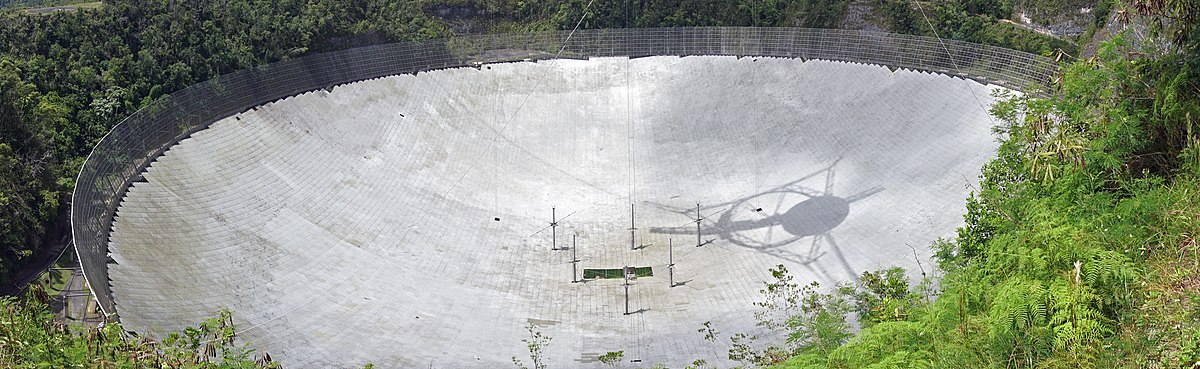 Ariciebo Telescope (Credit: Mario Roberto Durán Ortiz)
Perhaps the most famous radio telescope is Aricebo, located in Puerto Rico. Its thousand foot dish was one of the largest structures in the world when it was built, a structure worthy of being a backdrop for a James Bond film (GoldenEye). It has since been surpassed in its diameter by the the Five hundred meter Apeture Spherical Telescope (FAST) in China, as well as by telescope arrays such as the Jansky Very Large Array (VLA), but the scale of any of these instruments is nearly unparalleled. These telescopes can be so big because they don’t have to be precise to quite the same levels as optical telescopes, and in their size they allow for some incredibly fine resolution imaging of a very old Universe.
While the Aricebo telescope is likely the most famous radio telescope, it is no longer the candle-bearer which illuminates the cutting edge of our EoR understanding. The current standard in very low-wavelength astronomy such as that needed to see into the past. Two of the most state-of-the art instruments in radio astronomy, HERA and MWA, do not look like telescopes at all, and it would not be entirely surprising to confuse them with some other non-scientific apparatus.
These telescopes are not imaging telescopes in the way that a dish-type telescope is; instead, they belong to a distinct class of telescope that relies on a measurement method called interferometry. Interferometry is a significantly more computationally expensive means of looking into space by relying on the wave-like property of light to detect how much out-of-phase two antennas located some distance away from each other are.
For a single point source, this is fairly easy, the calculations relying on some trigonometry to calculate the location in the sky an object must be due to the slight phase difference between differing antennas. For an entire sky, however, this is impossible to do without a supercomputer, as all of space is emitting light at the telescope at the same time, which then has to be calculated back to the points in the sky from where they came.
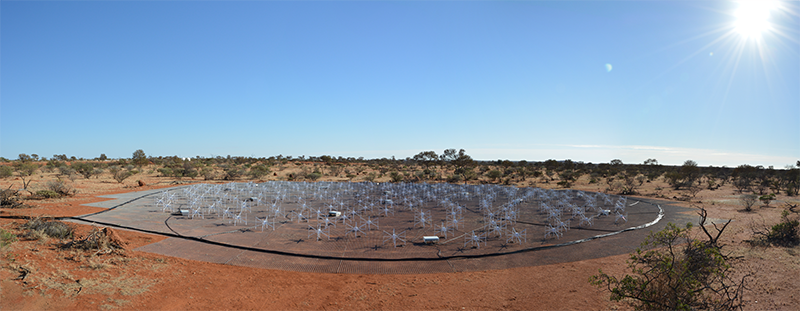 The MWA telescope (Credit: MWA)
Radio telescopes are particularly suitable for seeing the conditions of the universe, which can not only see the very faint backdrop of the fireball from which the Universe started, but also the tale told by a hint left in the quantum mechanics of the hydrogen atom.
This fascinating and very useful property of the hydrogen atom, which makes up the vast majority of the Universe, is its 21 centimeter spin-flip transition. Essentially, the hydrogen atom can undergo a spontaneous reorganization of its magnetic poles, releasing a vibration in the form of light that is 21 centimeters in wavelength.
It is this rare and random vibration that radio telescopes can use to map out where neutral hydrogen atoms live and therefore where the stuff in the Universe is. This map of neutral hydrogen, that which has not been perturbed by intense starlight, is the map of how energy and matter was and is distributed through our universe, and as such is one of the keys to mapping out the Epoch of Reionization, and in doing so, the formative years of the Universe of today.
Another particular piece of physics that bears mentioning here is the phenomenon of redshift. As we can see by the largeness of our current Universe compared to the tiny point where the Big Bang occured, the space we inhabit has grown quite a bit over the years. The fact that the Universe itself has grown larger means that waves, such as light, also get bigger with time along with it, drawing their wavelength out and lowering their energy. As the longest wavelength part of the visible spectrum is red, this phenomenon is termed “redshift”.
Redshift is both a blessing and a curse for looking into the early Universe and the EoR. Because light created at different times (wherein the Universe is of a different size) is correspondingly affected differently by this redshift effect, redshift is an excellent tool to seperate how old and how far away events are by the wavelength of particular emissions such as the 21 centimeter line mentioned earlier.
The Epoch of Reionization itself occured around a redshift in the neighborhood of 10: the Universe was ten times smaller than it is today, making the 21cm line emitted at the time to grow to 2.1 meters as we see it in telescopes on Earth. 2.1 meters is a very low energy wavelength, with a characteristic energy about four million times less than that of visible light, making it incredibly faint and hard to pick up.
To add to the difficulty of this situation, it is at this moment that it should be mentioned that the two-meter band of radio signals is one shared by another phenomenon. Sadly, this phenomenon is nowhere near as cool as the flight path of light leaving clouds of gas formed at the dawn of the Universe, and additionally is one that the forces of the scientific community have been unable to quash over its many years of existence.
The phenomenon, of course, is television. Television broadcasts occupy the meat of the EoR frequency range, greatly overpowering the light that filters in from billions of light-years away. It is for this reason that scientists must flee to the most remote regions of the world they can find, and the result is that the two interferometric telescopes aformentioned inhabit very sparse parts of South Africa and Austrailia, respectively.
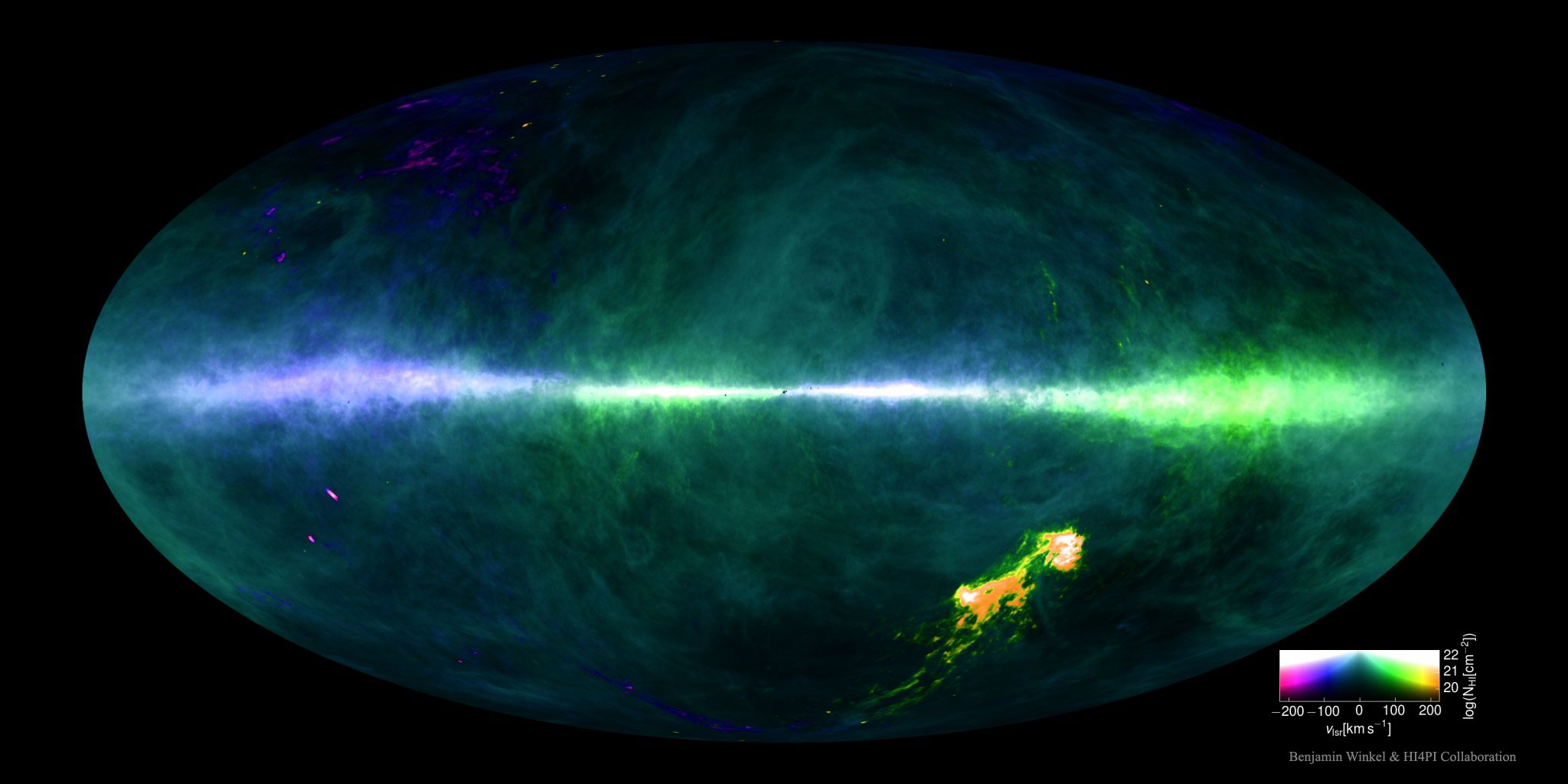 Map of the 21cm radio sky (Credit: Benjamin Winkel & the HI4PI Collaboration)
While this picture is swamped by our two nearest galaxies, the Milky Way and the Magellenic Clouds, its mapping of the neutral hydrogen is a key cog in understanding the Epoch of Reionization. The densities of neutral hydrogen gas in the Universe can tell astronomers how the Universe must have evolved to reach the state it is seen in today, as light from faraway hydrogen clouds at an earlier stage of the Universe reach our present day much later than when the light was generated. This is seen in the coloration of the map, where the nearby hydrogen is represented in green and orange while the redshifted hydrogen is seen in violet.
While the 21 cm line radio telescopes are only capable of viewing neutral hydrogen due to the physics of that particular transition, they are still very useful for understanding the morphology of the early universe, as hydrogen is not only the primary component of the universe but also the fuel that stars need to burn in order to emit light. Much as there is a tendency to see smoke where there is fire, astronomers can see accumulations of hydrogen with radio telescopes as a way of predicting where galaxies and stars may be coalescing.
While radio astronomy is perhaps the most widely used tool in probing the Epoch of Reionization, this article would be remiss in not briefly mentioning visible and infrared imaging of structures from this era. This is an exceptionally difficult task, as these objects are necessarily ~13 billion years old and the light has to have traveled towards Earth for that entire time, making objects from this era very dim and hard to detect. Indeed, evidence for galaxies (the smallest structures visible at these distances and lookback times) looks something like this:
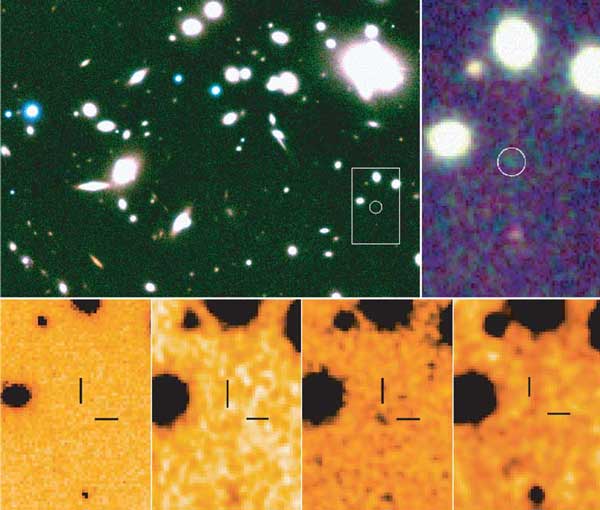
Potential z=10 galaxy observation (Credit: R. Pello, D. Schaerer et al., VLT, ESO)
Understandably, a great cover for Nature this does not make, and this is the cost of being the first generation to see so deeply into the Universe’s history. Even so, higher-frequency telescopes like the 8.2m visible-band telescope used to image this galaxy-like object are indeed useful cogs in finding the first structures the Universe assembled.
Notable galaxies imaged in this way include Cosmos Redshift 7 (seen as it was 800 million years after the Big Bang), EGSY8p7 (570 million years old), and GN-z11 (400 million years old); these very old galaxies, seen as they were about 13 billion years ago, complement the radio telescope findings of hydrogen to help compete a picture of the Universe in these early days.
Taking pictures of stars is perhaps the most obvious and straightforward way to confirm the existence of stars, and it is this task that is not possible using radio telescopes which are tuned to the much lower 21 cm emissions. The actual imaging of galaxies and their stars serves as a useful direct check as to the prevalence of stars and order in the early universe which can otherwise only be infered by the 21cm family of telescopes.
While the study of the EoR itself looks very much into the past, the fundamental objective shared with other sciences is not lost. Science, as a method, is the task of looking at past events (in non astronomical sciences, usually set up as an experiment) to draw conclusions that illuminate how existence works for later times where we may want to predict something.
The study of the EoR, in particular, has its data collected from events very, very far in the past, but the goal of this study remains the same as other science: to catch as large of a glimpse of the future as we can by rummaging through the past (a nice bonus for studying the EoR is that the “future” that it predicts also includes most of the history of the Earth).
In this glimpse we’ve gotten of the EoR we see our own birth: the transformation of a smooth universe into a clumpy, nonhomogeneous universe with the energy flow that makes life possible. Not only does this period of our history show the creation of our universe, but also the stars born of it would create the first heavy atoms which would go on to build the Earth and Solar System we live in today.
Our understanding of the Epoch of Reionization is rapidly emerging, and with any luck, soon we will be able to pry back the lid a little more and capture this period in the Universe’s history a little better. With any luck, we’ll soon be able to live in the past just a little more.∎
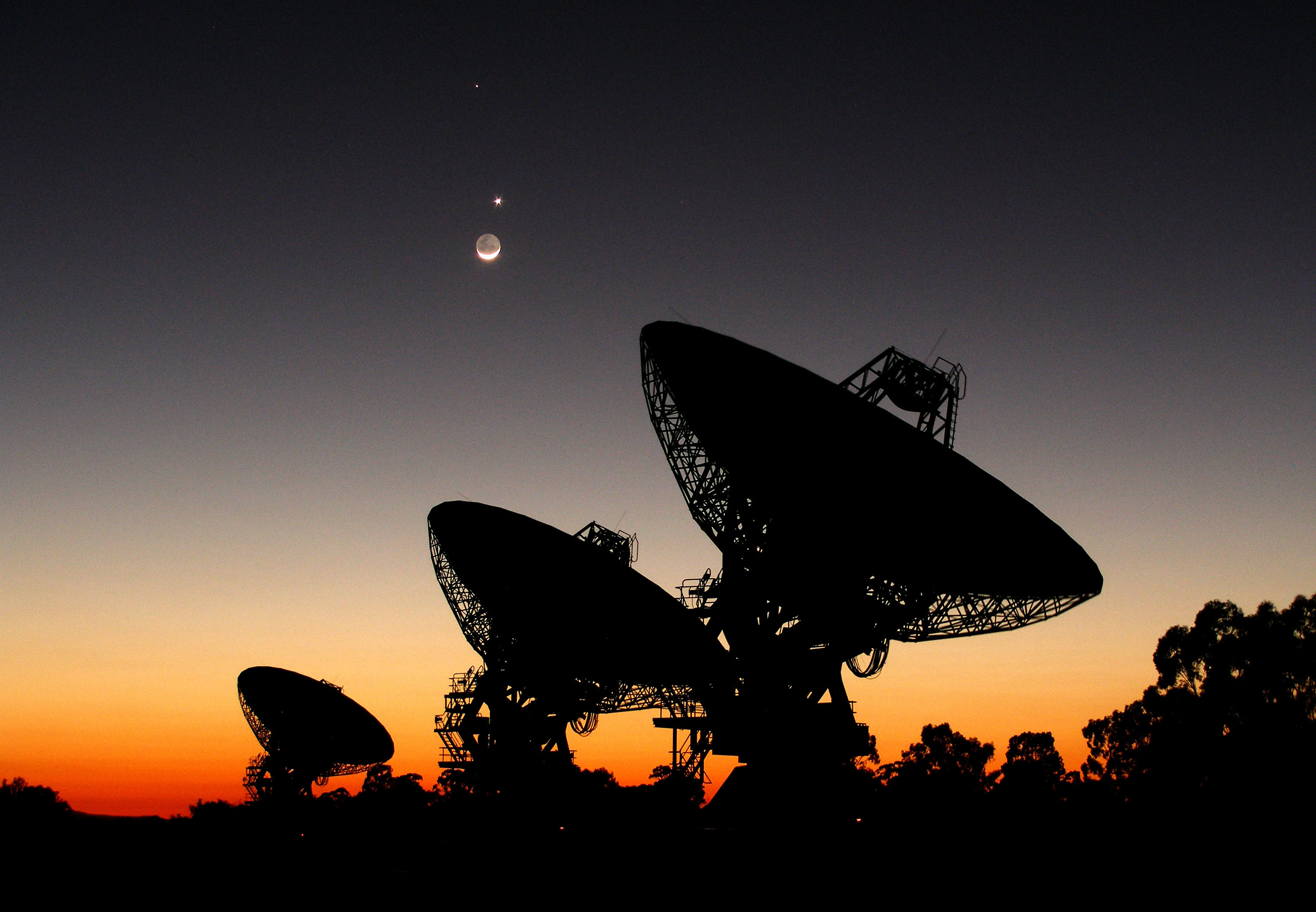 ATCA (Credit: Graeme L. White & Glen Cozens (James Cook University))
A syzygy over the Australia Telescope Compact Array radio telescopes.